
Library technology should make everyday work easier. But when managing the systems becomes a job of its own, the real cost isn't always reflected in a software invoice.
It's Tuesday morning at the library, and Thursday's children's program is already full.
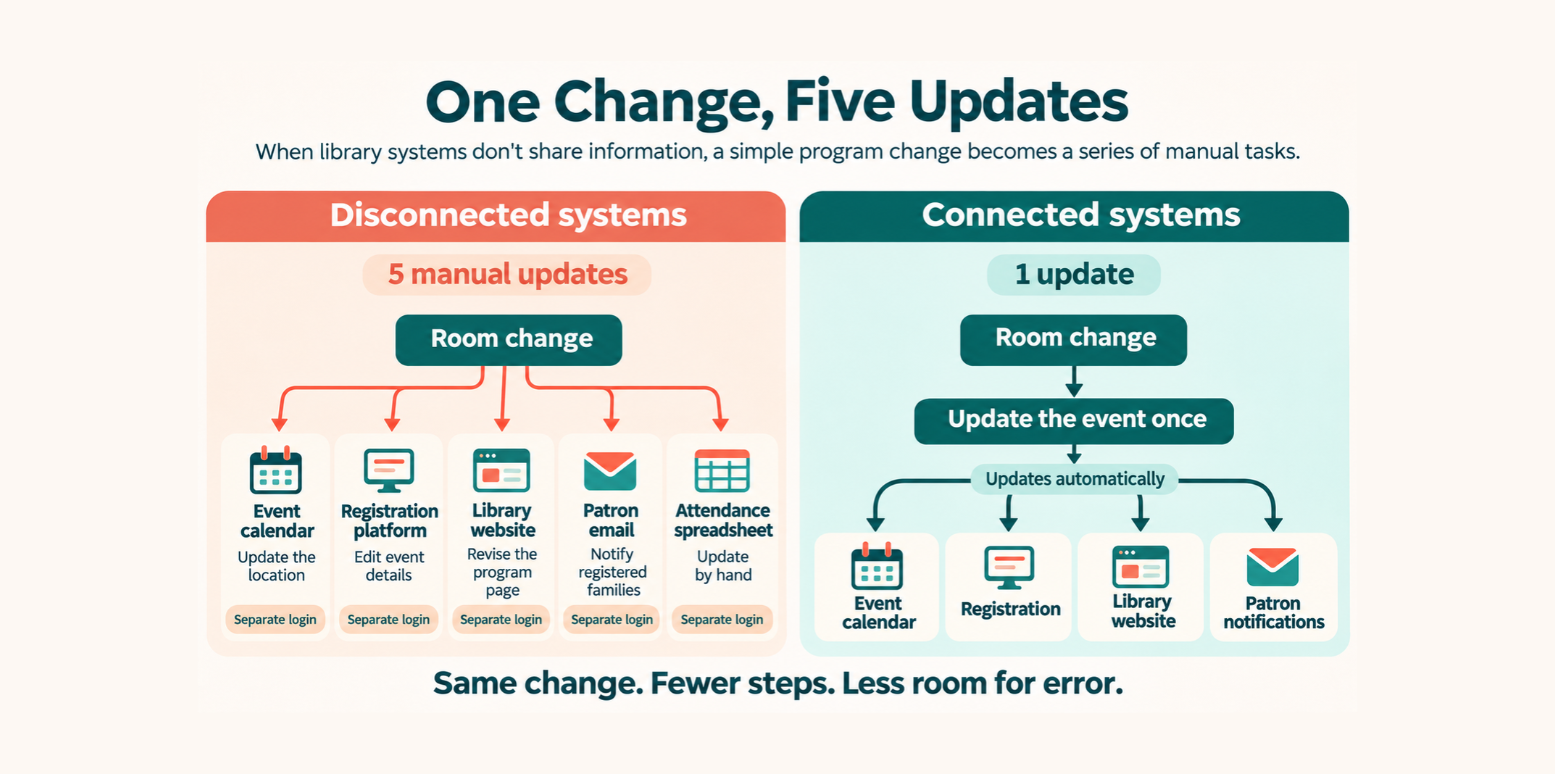
A parent calls to ask about the waitlist. Another needs to cancel a registration. Meanwhile, the program coordinator is preparing for a room change, updating the event calendar, and making sure registered families receive the correct information.
None of these responsibilities is particularly complicated. They're simply part of running a successful library program. But there's a catch. The calendar, registration platform, website, and patron communications don't necessarily share information. Updating one doesn't automatically update the others.
What should be a straightforward adjustment becomes a series of small administrative tasks, each requiring another login, another update, and another opportunity for information to get lost along the way. By the time everything is finished, a good portion of the morning has disappeared.
For library professionals, this scenario probably sounds familiar. Behind every well-attended storytime, community workshop, or summer reading event is an enormous amount of coordination that patrons rarely see. Technology is supposed to simplify that work. Yet for many libraries, the challenge isn't a lack of digital tools. It's the amount of effort required to make those tools work together.
And over time, that effort adds up.
When Everyday Workflows Become Unnecessarily Complicated
Libraries have invested in technology to support nearly every aspect of their operations. Event calendars help communities discover programs. Registration platforms manage attendance. Integrated library systems (ILS) maintain patron information, while reservation tools, email platforms, and reporting systems support everything happening behind the scenes.
Individually, these solutions may work exactly as intended. The difficulty emerges in the spaces between them.
Consider the process of organizing a single library program. Staff create the event, establish registration requirements, reserve a room, prepare promotional materials, and communicate important details to patrons. Depending on the library's technology, each responsibility may involve a different platform. When information changes, staff must determine which systems need to be updated and whether those changes have reached everyone affected.
A room change might appear in an email but not on the public calendar. A canceled registration may need to be removed manually from an attendance spreadsheet. A patron's library card eligibility might require verification through a separate system before registration can be completed.
These aren't necessarily major technical failures. They're ordinary operational challenges that arise when systems function independently.
And because library staff are exceptionally resourceful, they often find ways to work around them.
Shared spreadsheets become unofficial reporting systems. Checklists help employees remember which platforms need updating. Informal processes develop to ensure information stays consistent across departments. Eventually, these workarounds become part of the daily routine.
That's what makes the problem difficult to recognize. When a process has always required five steps, it's easy to overlook the possibility that it should only require two. Multiply those extra steps across dozens of programs, multiple staff members, and several library branches, and the impact becomes much more significant.
The hidden cost of disconnected library technology isn't always another subscription or maintenance expense. Often, it's the staff time required to keep everything running.
The Time Libraries Can't Afford to Lose
Library professionals are accustomed to balancing competing priorities. On any given day, they may be developing programs, supporting patrons, coordinating community partnerships, managing facilities, and responding to unexpected needs.
Administrative responsibilities are an important part of that work. But not every administrative step contributes meaningful value.
Manually transferring registration information between systems doesn't improve a program. Reentering the same event details in multiple places doesn't strengthen community engagement. Spending an afternoon reconciling attendance reports doesn't create a better experience for patrons.
These tasks are necessary only because the technology requires them. For libraries operating with limited staffing and growing community expectations, that distinction matters.
Improving staff efficiency shouldn't mean asking employees to work faster or take on more responsibilities. It should mean examining where unnecessary work exists and finding practical ways to eliminate it. At LocalHop, connected library workflows help save more than three hours of staff time each week.
Three hours might not sound transformative at first. But consider what that time could mean for a programming coordinator preparing an upcoming event, a librarian developing a new community partnership, or a staff member who finally has more time to help patrons face-to-face.
Across an entire year, those hours represent meaningful capacity that can return to the library's mission. And the benefits don't stop with staff. When technology creates friction behind the scenes, patrons can experience it, too.
Someone registering for a workshop shouldn't need to navigate several unfamiliar pages to complete the process. A family planning to attend storytime should be able to trust that the calendar reflects the correct location and schedule. A patron reserving a community room shouldn't have to make an additional phone call simply to confirm that their request went through.
These interactions may seem small, but they influence how easily people can participate in library services.The best library technology makes that participation feel effortless, even when the operations supporting it are anything but simple.
What Happens When the Systems Finally Work Together?
The impact of connected technology becomes especially apparent when libraries must coordinate services beyond a single building.
The Iowa Adventure Pass program offers a compelling example.
Designed to connect library patrons with educational and recreational experiences throughout Iowa, the program involved 70 participating libraries. Behind the scenes, however, managing the initiative had become increasingly complicated.
Three librarians were responsible for coordinating the statewide program. Changes to participating venues and program information required individualized updates across libraries, creating a significant administrative burden for a small team.
The challenge wasn't a lack of organization or commitment. The program had simply outgrown the processes supporting it.
When the Iowa Adventure Pass program partnered with LocalHop, the focus was on simplifying how participating libraries worked together. Rather than requiring individual changes across dozens of locations, the new centralized platform allowed venue information to be updated once and reflected across all 70 participating libraries.
Custom ILS integrations accommodated the different systems libraries were already using, while centralized management gave the coordinating committee greater independence over day-to-day operations. The replacement platform launched in just three months.
The significance of that transition goes beyond the implementation timeline. It demonstrates what becomes possible when technology is designed around the way libraries actually operate. The librarians coordinating Iowa Adventure Pass could spend less time managing repetitive updates and more time supporting a program that connects communities with valuable experiences.
For a statewide initiative, removing administrative barriers can improve collaboration across dozens of organizations. For an individual library, the same principle might mean simplifying registration for a weekly program or reducing the steps required to reserve a meeting room. The scale may differ, but the underlying opportunity remains the same.
When systems work together, staff have more freedom to focus on the people and programs those systems are meant to support.
Choosing Technology That Works With Your Library
Of course, recognizing the cost of disconnected systems doesn't mean libraries need to replace every tool they currently use. In many cases, the better starting point is understanding how existing technology fits into daily operations.
A library may already have a dependable ILS, an established website, and tools that staff know well. Introducing another platform without considering those investments could create more complexity rather than less.
Instead, technology decisions should begin with the work itself.
Where are employees entering the same information more than once? Which tasks require switching between multiple platforms? How easily can staff communicate program changes to registered patrons? Can administrators understand attendance and engagement without manually combining reports?
These questions reveal more about a library's operational needs than a lengthy comparison of software features.

Integration is particularly important. When registration platforms can communicate with existing library systems, processes such as library card verification become easier to manage without requiring staff to perform additional checks.
The same applies to reporting and patron communications. Information that's already available within a system should be useful throughout the workflow, rather than requiring employees to collect and reenter it elsewhere.
Accessibility and ease of use also deserve attention. A platform might offer extensive functionality, but if staff struggle to navigate it or patrons encounter unnecessary barriers, those features provide limited value. Ultimately, the goal isn't to find the technology with the longest list of capabilities. It's to find technology that makes the library's existing responsibilities easier to manage.
Better Library Technology Starts With Listening
No two libraries operate in exactly the same way.
A small community library organizing a handful of weekly programs faces different challenges than a multi-branch system coordinating hundreds of events. Staffing structures, community needs, existing technology, and available resources all influence how services are delivered.
That's why effective library technology can't rely on a one-size-fits-all approach. It requires understanding how library professionals work, where challenges occur, and which improvements will make a meaningful difference.
That philosophy has shaped LocalHop's development since 2015.
What began as a community event discovery platform evolved as library professionals shared the operational challenges they were encountering. Disconnected registration systems, manual patron verification, complicated room reservations, and fragmented workflows all helped inform how the platform developed.
Today, LocalHop supports more than 1,000 libraries, with 70+ custom integrations designed to connect library technology with existing operations. Those numbers reflect the scale of the platform, but they also tell a larger story about the value of listening to the people using technology every day.
Libraries identified the challenges. LocalHop worked alongside them to develop practical solutions. And that collaboration doesn't end when a platform launches.
Library needs evolve as communities grow, programming changes, and new services emerge. A technology partner should be prepared to evolve alongside those needs, continuing to improve the experience for staff and patrons rather than expecting libraries to adapt their operations around rigid software.
Because successful technology partnerships aren't defined solely by implementation. They're defined by how well the technology continues to serve the people relying on it.
Giving Time Back to What Matters
Think back to that Tuesday morning at the library.
The program coordinator still has a full schedule. There are patrons to assist, events to prepare, and community needs to address. Those responsibilities aren't going away, nor should they. But the unnecessary steps surrounding them can.
When calendars, registration, reservations, communications, and reporting work together, staff spend less time managing information across platforms. Changes become easier to communicate, daily workflows become more consistent, and patrons encounter fewer obstacles when accessing library services. The real value isn't simply completing administrative tasks faster. It's creating more room for the work that makes libraries essential to their communities.
Technology should never compete with that mission for staff time and attention. It should help protect both. At LocalHop, we believe the best library technology is built around the people who use it, shaped by their experiences, and designed to make their work easier.
Because every program deserves the opportunity to succeed, every patron deserves a welcoming experience, and every library team deserves technology that works as hard as they do.
Ready to spend less time managing systems and more time connecting with your community?